

Implementation

 15 minutes
 Primary school
Intelligent Paper
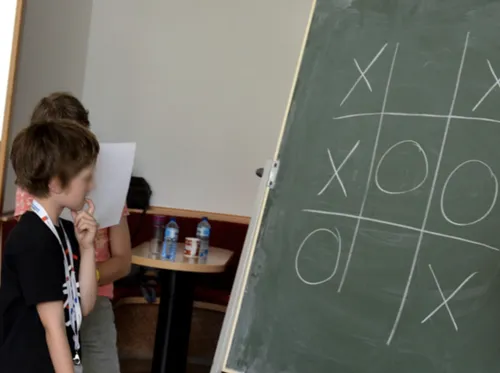
In this activity, students play Tic-Tac-Toe against an “intelligent paper” that follows a set of fixed rules (for example, “if the opponent does this, do that”) to ensure the white player can at least tie and sometimes win. This sparks a discussion about intelligence: students usually conclude that the paper itself isn’t intelligent—the person who wrote the rules is. They then agree that a computer would be considered intelligent if it could learn the rules by itself, which naturally leads into the Candy Computer activity, where the system discovers strategies through learning from mistakes.
This activity was developed by Paul Curzon at Queen Mary University of London and is published as part of CS Unplugged.

Relevance to everyday life
In this activity, we address important questions: What is artificial intelligence? Would a computer that learns to play a game optimally (e.g., chess) be considered intelligent? Is artificial intelligence even possible?

Connection with the curriculum
The activity belongs to computer science.