

Implementation

 1-2 hours
 Primary school
Candy Computer
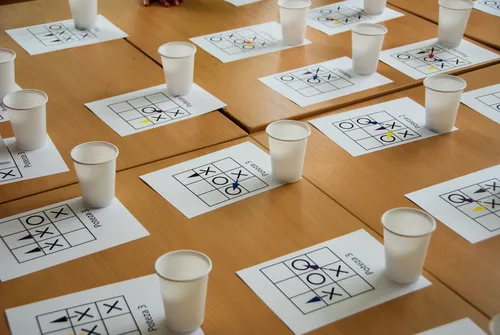
As a follow-up to Intelligent Paper, students get to build a computer out of candies that learns to play a simple game with six pawns (Hexapawn). At first, the “computer” is completely clueless — making random moves and sometimes missing an easy win — but as it learns from its mistakes, it gradually becomes unbeatable.
This hands-on activity is a bit of work to set up, but it’s always a hit with students. While they play, it naturally sparks discussions about how learning happens. Where is intelligence? Is each candy — or each cup of candies — becoming more intelligent with each game? These questions can even lead to bigger debates, like: can a machine truly be intelligent?
The activity comes from CS4FN: The Sweet Learning Computer, part of the CS4FN project started by Paul Curzon and Peter McOwan at Queen Mary University of London.

Relevance to everyday life
In this activity, we address important questions: What exactly is artificial intelligence? What does it mean for a computer to learn? Would a computer that learns to play a game optimally (e.g., chess) be intelligent? Is artificial intelligence even possible or not?

Connection with the curriculum
This activity belongs to computer science.