

Implementation

 1 hour
 any
Language Clustering
This activity nicely follows exploration of letter frequency histograms in different languages and climate zones.
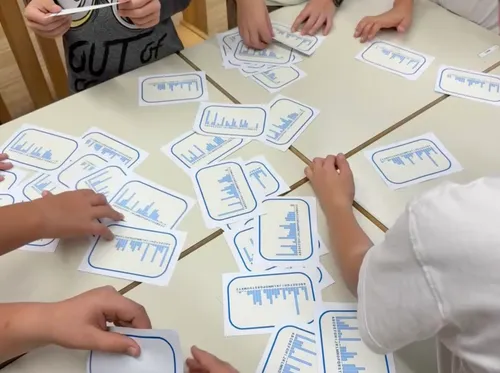
During the latter, students learn the concept of clustering. Now they try to apply it to languages — and discover that it doesn’t work very well, because they get overwhelmed by the large number of features (letters), which are difficult to compare, and by the large number of languages.
After frustrating them in the first part of the activity, we show them how brilliantly a computer can perform this task. The computer uses a method they are already familiar with, having applied it themselves in the climate activity, but on a scale and with a level of precision that would be too demanding for a human.

Relevance to everyday life
When working with data, we often encounter situations where we only know the characteristics of things. We would like to create groups containing things that are similar to one another. For example, a shop has data about its customers' shopping habits and wants to group similar customers together so that it can more easily prepare its advertising campaign. There are several clustering methods; in this activity, we learn how to create clusters based on similarity.

Connection with the curriculum
This activity is suitable for various language lessons. In addition to clustering, it also provides an opportunity to review language families.