


 1 hour
 4. grade
Animal Tree
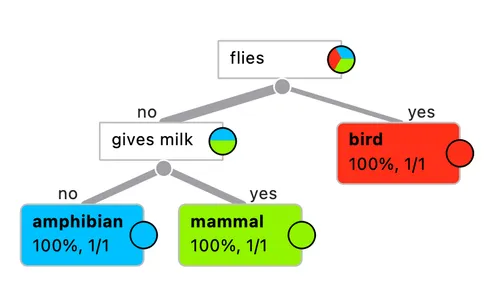
By gradually introducing different kinds of animals and their distinguishing features (such as has wings or gives milk), the computer learns to differentiate between mammals, birds, insects, and other groups.
Students often become highly engaged as they try to think of animals that “break” the current rules and force the introduction of new features. The a-ha moment typically comes at the end, when they realize that the same principle can be used to teach a computer to recognize poisonous mushrooms, predict which drug will be effective for a patient, classify emails as spam or not, or identify objects in images.

Relevance to everyday life
Just like recommender systems, predictive models are everywhere. Meteorologists use them to forecast weather, banks to detect suspicious transactions, email inboxes to filter spam, mobile service providers to try and predict which customers will switch to competitors, drug developers study the effects of new compounds, and cars are getting better and better at recognizing obstacles on the road.

Connection with the curriculum
The activity is well suited as a wrap-up after studying animal classification (vertebrates and invertebrates; mollusks, reptiles, birds, fish, etc.), as it helps students thoroughly review the defining features of different groups as well as individual animals (for example: Are dolphins fish? Do penguins have fur?).